IFRS 16 Lease Model in Quantrix: From Classification to Journal Entries, with Formulas You Can Read
In short: This is a free IFRS 16 lease model for lessees, built in Quantrix and tested with 4 500 leases. The demonstration version takes 12 leases of a fictitious telecoms company, small enough to trace every rule by hand, through every step of IFRS 16: does the contract contain a lease, what is the lease term, is it short-term or low-value, and if it is capitalised, the lease liability, the right-of-use asset, the monthly schedule and the journal entries. It is not a black box: every calculation is a named formula you can read, check and change. The model checks itself and shows PASS or REVIEW. It comes free with the 30-day Quantrix trial.
Key facts
| Leases | 12, each chosen to test a different IFRS 16 rule |
| Legal entities | 2 (Austria, Germany), each with its own incremental borrowing rate |
| Asset classes | Towers and sites, offices, vehicles, IT equipment, network capacity |
| Horizon | 6 years, monthly, EUR |
| Scenarios | Base · Strict Policy (stricter accounting policy: short-term election off, low-value threshold EUR 2 500) · Higher Rate (incremental borrowing rate +200 bp) |
| Classification | Not a lease → short-term → low-value → capitalised |
| Outputs | Lease liability and right-of-use schedules, interest, depreciation, expense, journal entries, reports by entity and by classification |
| Scale | Tested with 4 500 leases. A larger portfolio means more items and more data, not more formulas |
| Transparency | 91 named formulas, readable without decoding cell addresses |
| Built-in checks | Journals balance, liability and right-of-use asset checked against independent calculations every month; PASS in all three scenarios |
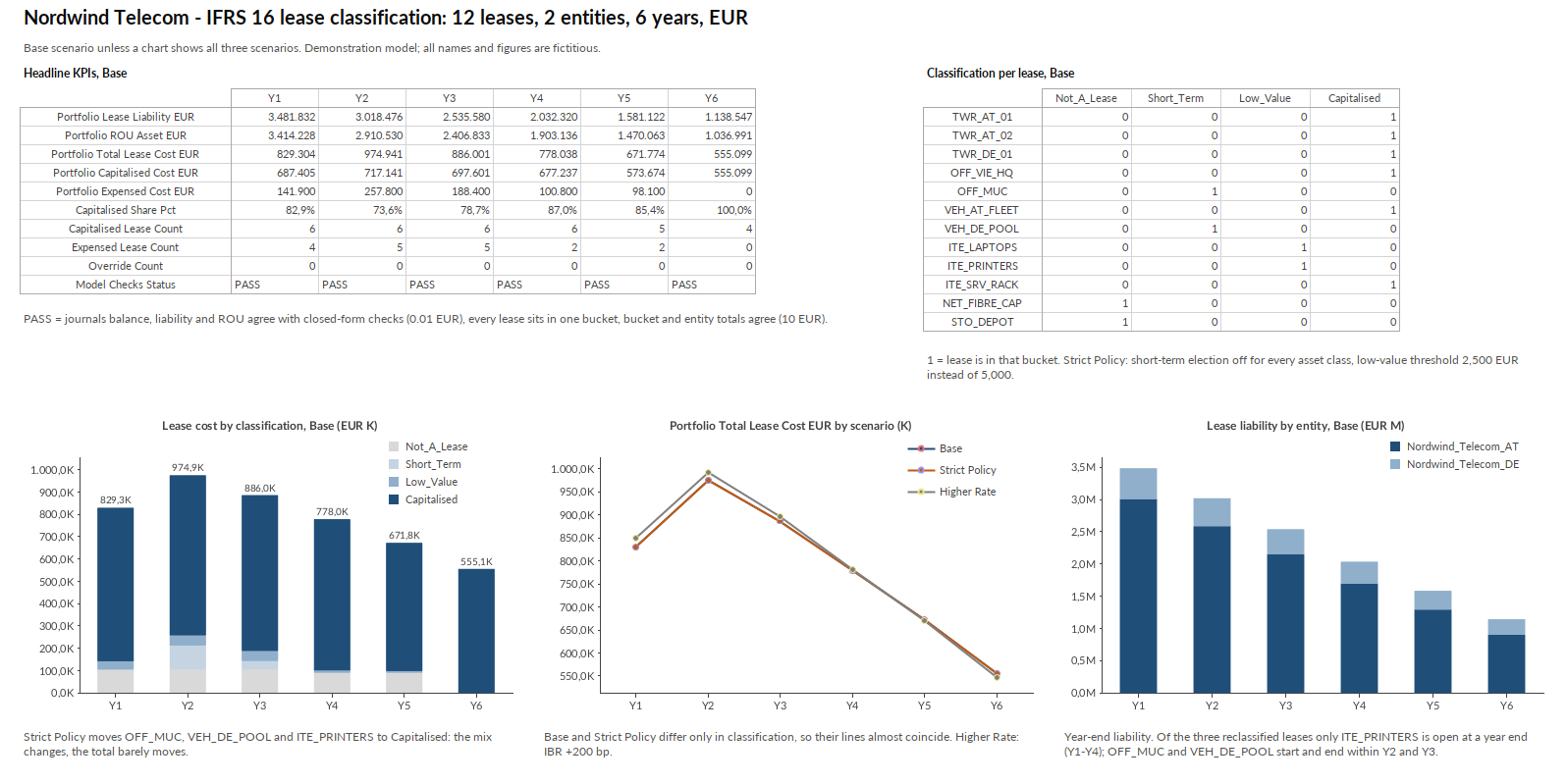
| Base results, year 1 | Total lease cost EUR 829 304 · year-end lease liability EUR 3 481 832 · right-of-use asset EUR 3 414 228 |
| Availability | Free with the 30-day Quantrix trial |
What is an IFRS 16 lease model?
An IFRS 16 lease model decides, for each contract, whether it goes on the balance sheet, and if it does, calculates the lease liability, the right-of-use asset and how both change over time. Under IFRS 16 a lessee recognises almost every lease on the balance sheet. The exceptions are contracts that are not leases, short-term leases and leases of low-value assets, where the company chooses to use those exemptions.
Most companies do this either in Excel, with one schedule per lease, or in dedicated lease accounting software. Excel is flexible but fragile: copied schedules, hand-built journals and no warning when one lease is wrong. Software is controlled but often a black box: you see the result, not how it was calculated. This model sits in between: one structured model, every calculation visible as a formula.
Which leases are in the model?
The 12 leases belong to a fictitious telecoms lessee with entities in Austria and Germany. Each one tests a different IFRS 16 rule, so the model shows how the standard handles real-world contract features:
| Lease | What it tests |
|---|---|
| TWR_AT_01 | Extension option reasonably certain |
| TWR_AT_02 | Service component split out |
| TWR_DE_01 | Termination option not reasonably certain |
| OFF_VIE_HQ | Head office with initial direct costs and a lease incentive |
| OFF_MUC | 11-month project office |
| VEH_AT_FLEET | Vehicle fleet with a maintenance component |
| VEH_DE_POOL | Exactly 12 months: the short-term boundary |
| ITE_LAPTOPS | Low-value per item |
| ITE_PRINTERS | Low-value status depends on the threshold |
| ITE_SRV_RACK | Bargain purchase option |
| NET_FIBRE_CAP | Capacity share with no identified asset |
| STO_DEPOT | Supplier has a substantive substitution right |
Does the model handle thousands of leases?
Yes. The demonstration has 12 leases so that every IFRS 16 rule can be followed by hand, but large lessees, such as telecoms operators with towers, sites, offices and vehicle fleets, often have thousands. We tested the same model with 4 500 leases, and Quantrix handles portfolios of that size easily.
The reason is the structure. A lease is an item in the Lease dimension, so a larger portfolio means more items and more data, not more formulas: the same 91 formulas classify, measure, schedule, journalise and check 12 leases or 4 500. In a spreadsheet, every additional lease is another schedule to copy and keep in step.
How do you know if a contract contains a lease under IFRS 16?
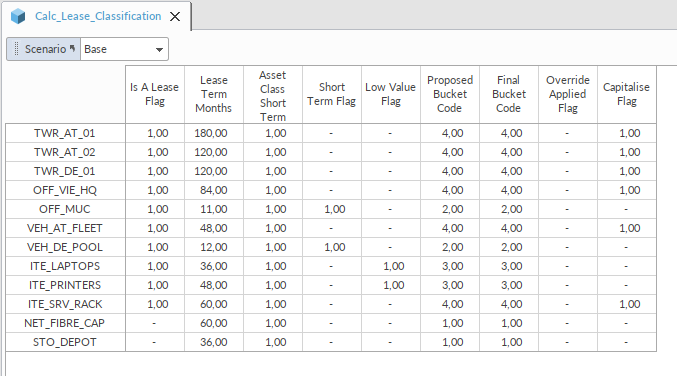
A contract contains a lease if there is an identified asset and the customer has the right to obtain substantially all of its economic benefits and to direct its use. If the supplier has a substantive right to substitute the asset, there is no identified asset and no lease. The model tests each of these conditions per contract. Two contracts fail them: a share of fibre capacity with no identified asset (NET_FIBRE_CAP), and a storage depot where the supplier can substitute the space (STO_DEPOT). Their payments are expensed.
How is the lease term determined?
The lease term is the non-cancellable period, plus periods covered by an extension option the lessee is reasonably certain to exercise, plus periods covered by a termination option it is reasonably certain not to exercise (IFRS 16.18). In the model, both judgements are flags per lease, so the lease term is one formula:
Lease Term Months = Assum_Lease_Terms::Non Cancellable Months
  + Assum_Lease_Terms::Extension Option Months * Assum_Lease_Flags::Extension RC Flag
  + Assum_Lease_Terms::Termination Option Months * (1 - Assum_Lease_Flags::Termination RC Flag)
A judgement comment can be recorded next to each lease, so the reasoning sits next to the number.
When is a lease short-term or low-value under IFRS 16?
A lease is short-term if its lease term is 12 months or less and it contains no purchase option; the election is made per class of underlying asset. A lease is low-value if the underlying asset is of low value when new; IFRS 16 sets no amount, but the Basis for Conclusions refers to assets of around USD 5 000 or less, and the election can be made lease by lease. A subleased asset, or one that cannot be used on its own, does not qualify.
In the model, the short-term election is an input per asset class and the low-value threshold an input per scenario: EUR 5 000 in Base, EUR 2 500 in Strict Policy. The 12-month limit is part of the formula, because the standard defines it. The model applies the tests in the order of the standard: not a lease, short-term, low-value, otherwise capitalise. An accountant can override the result for any lease; overrides are counted and shown on the dashboard.
How do you calculate the IFRS 16 lease liability? A worked example
The lease liability is the present value of the lease payments over the lease term, discounted at the interest rate implicit in the lease or, if that cannot be readily determined, the lessee’s incremental borrowing rate. Payments include a purchase option price if exercise is reasonably certain.
Take the tower lease TWR_AT_01 from the model:
- Fixed payment EUR 4 200 a month, paid in arrears
- 120 months non-cancellable plus a 60-month extension the company is reasonably certain to exercise: a lease term of 180 months
- Incremental borrowing rate of the Austrian entity 4.25% a year, converted to an effective monthly rate of 0.3474%
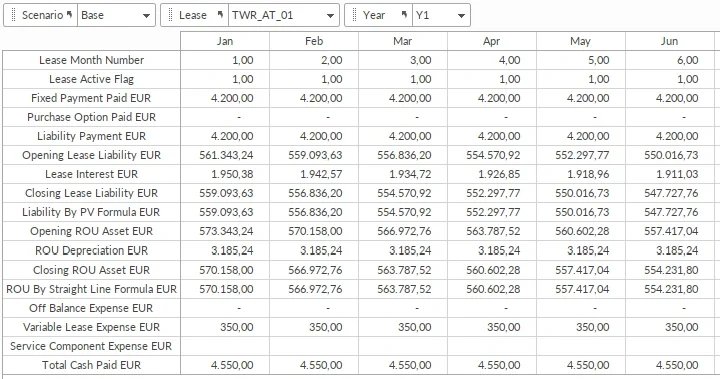
The present value of 180 payments of EUR 4 200 at that rate is the initial lease liability: EUR 561 343. The model uses the closed-form present-value formula rather than summing a schedule, because many leases run beyond the six-year horizon.
How is the right-of-use asset calculated and depreciated?
The right-of-use asset at commencement is the lease liability plus initial direct costs, plus payments made at or before commencement, less lease incentives received (IFRS 16.24). It is depreciated over the lease term, or over the useful life of the asset if ownership transfers or a purchase option is reasonably certain to be exercised (IFRS 16.32).
For the tower lease, initial direct costs of EUR 12 000 give a right-of-use asset of EUR 573 343. The lease term of 180 months is shorter than the 300-month useful life, so it is depreciated over 180 months: EUR 3 185 a month.
What are the IFRS 16 journal entries for a lessee?
At commencement, the lessee debits the right-of-use asset and credits the lease liability and, for initial direct costs, cash. Each month it then records interest on the liability, the payment, depreciation of the right-of-use asset, and any payments that are expensed directly. For the tower lease, month 1:
| Entry | Debit EUR | Credit EUR |
|---|---|---|
| Commencement: right-of-use asset | 573 343 | |
| Commencement: lease liability | 561 343 | |
| Commencement: cash (initial direct costs) | 12 000 | |
| Interest on the lease liability | 1 950 | |
| Lease liability (payment less interest) | 2 250 | |
| Cash (fixed payment) | 4 200 | |
| Depreciation expense / accumulated depreciation | 3 185 | 3 185 |
| Variable lease payment, expensed / cash | 350 | 350 |
The model writes these entries for every lease and month and checks that each set balances. Leases that are not capitalised go straight to lease expense. Variable payments and service components are always expensed (IFRS 16.38, 16.12).
What happens when the accounting policy changes?
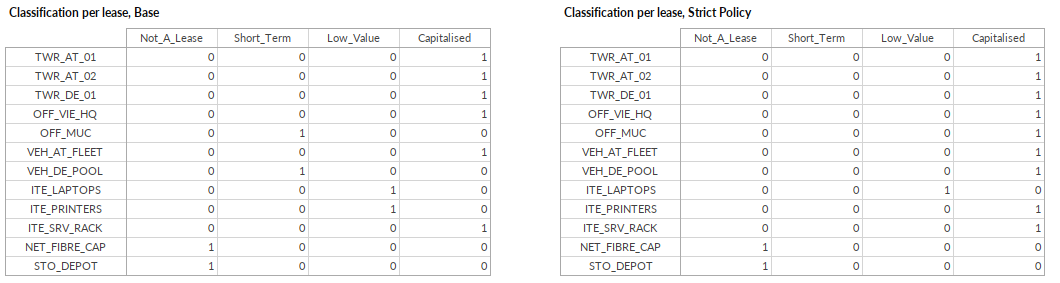
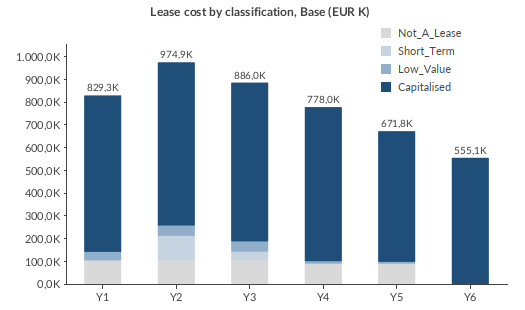
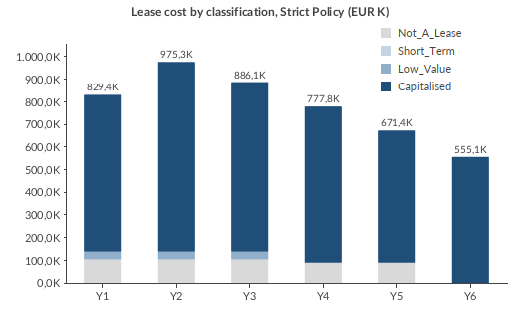
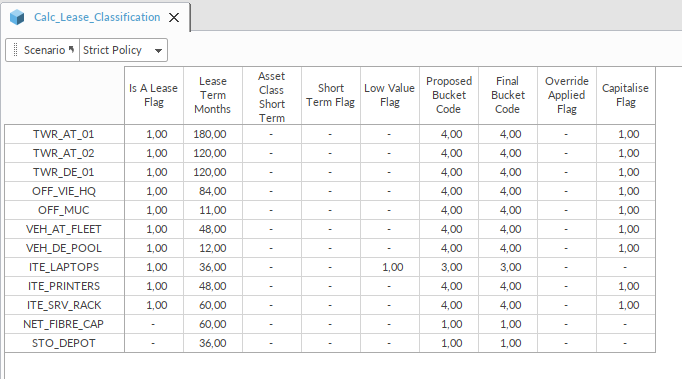
A stricter policy changes the classification, the P&L lines and the balance sheet, while total lease cost stays almost the same. In the Strict Policy scenario the company switches off the short-term election and lowers the low-value threshold from EUR 5 000 to EUR 2 500. Three leases move to Capitalised: the Munich project office (OFF_MUC), the vehicle pool (VEH_DE_POOL) and the printers (ITE_PRINTERS).
| Base | Strict Policy | |
|---|---|---|
| Total lease cost, year 1 | EUR 829 304 | EUR 829 431 |
| Total lease cost, year 2 | EUR 974 941 | EUR 975 285 |
| Capitalised cost, year 2 | EUR 717 141 | EUR 836 084 |
| Expensed cost, year 2 | EUR 257 800 | EUR 139 200 |
| Capitalised share, year 2 | 73.6% | 85.7% |
| Capitalised leases, years 2 and 3 | 6 | 8 |
| Year-end lease liability, year 1 | EUR 3 481 832 | EUR 3 509 037 |
The balance sheet effect is small by design. The Munich office and the vehicle pool start and end within one year, so they never appear in a year-end balance; only the printers add to the year-1 liability, by EUR 27 205. The point for a policy decision is visible anyway: classification and cost lines change, total cost barely moves, and the model shows exactly which leases moved and why.
How does the model check itself?
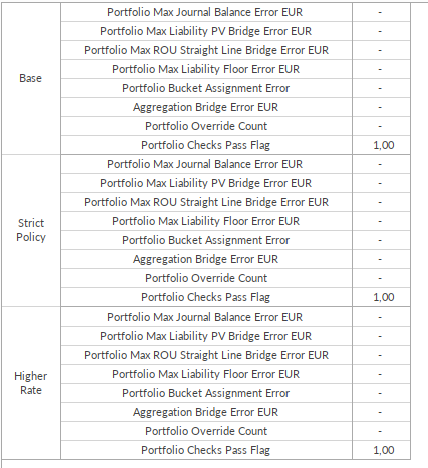
The model checks every lease and month and shows the result as PASS or REVIEW; in all three scenarios the status is PASS. A lease schedule can add up and still be wrong, so the checks compare the model against independent calculations:
- Journal entries balance every month, to 0.01 EUR
- The lease liability matches a closed-form present-value calculation every month, to 0.01 EUR
- The right-of-use asset matches a straight-line calculation every month, to 0.01 EUR
- The liability never goes below zero
- Every lease sits in exactly one classification bucket
- Totals by classification equal totals by legal entity
The checks were tested by breaking the model on purpose: an invalid override and a missing entity mapping both turned the status to REVIEW.
Is the model a black box?
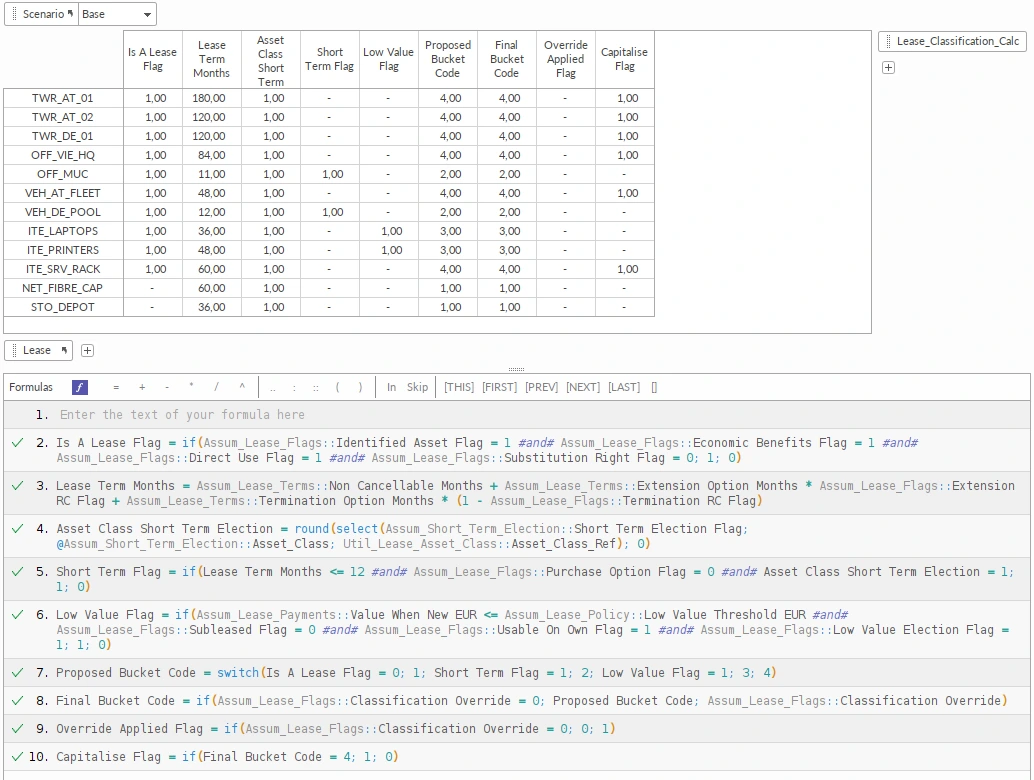
No. Every number comes from a named formula you can open and read, written in the terms of the standard rather than in cell addresses. The classification, for example, is one line:
Proposed Bucket Code = switch(Is A Lease Flag = 0, 1, Short Term Flag = 1, 2, Low Value Flag = 1, 3, 4)
and the right-of-use asset of IFRS 16.24 is another:
Initial ROU Asset EUR = if(Calc_Lease_Classification::Capitalise Flag = 1,
  Initial Lease Liability EUR + Assum_Lease_Payments::Initial Direct Costs EUR
  - Assum_Lease_Payments::Lease Incentives EUR, 0)
Each formula applies to all 12 leases in all three scenarios, so an auditor or a new team member reviews 91 formulas instead of thousands of copied cells. Because the model is yours, you can change it too: add a lease, an entity or an asset class, change a policy, or add what your company needs, such as a current and non-current split of the liability.
Why build an IFRS 16 model in Quantrix rather than Excel?
In Quantrix, Lease, Legal Entity, Year, Month and Scenario are dimensions of one model, so one formula covers every lease, month and scenario. In Excel, twelve leases in three scenarios usually means 36 copies of the same schedule, and a policy change means checking each of them. Here the classification is one decision per lease that every schedule, journal and report reads, and a thirteenth lease is one item plus its contract data.
How was this model built?
The model was generated from a plain-language brief with our AI Quantrix model builder: a model definition of 22 matrices with 71 structure rows and 91 formulas, and sample data for three scenarios, following our modelling rule set. The definition was verified automatically before import and built in Quantrix by our import scripts. The dashboard was generated by script from the model’s existing matrices. The same method works for your own lease portfolio, entities and accounting policies.
What does the model not include?
It demonstrates lessee accounting under IFRS 16; it is not a complete lease accounting system:
- No remeasurement or modification of leases, such as an index-linked rent reset or an exercised extension
- No second book (local GAAP) side by side
- No split of the liability into current and non-current
- No EBITDA impact KPI
- No mapping of journal entries to general ledger accounts
- No stepped rent or rent-free periods
- No lease payments made before commencement (prepayments)
- Lessee side only, no lessor accounting
Each of these can be added to the model, because its structure and formulas are open.
Get the model with your free trial
The model is included with the free 30-day Quantrix trial. Request the trial below and we will send you the model with the download link. If you would like it adapted to your own lease portfolio, say so in the message field.
Get Full Access to Quantrix – Free for 30 Days
We ask for a few details to send your download link and help you get started. Your info stays private, no spam, no credit card.
Why It is Worth Your Time: