Holding Company Consolidation Model in Quantrix: 7 Entities, 5 Currencies, Automatic Eliminations
In short: This is a free demonstration model for group consolidation, built in Quantrix. It consolidates a fictitious Austrian holding with six subsidiaries in five currencies (EUR, PLN, CZK, CHF, HUF) over ten years and three scenarios. It eliminates intercompany sales, fees, interest, loans and trade balances, calculates non-controlling interests and the currency translation reserve per entity (IAS 21), and checks itself: the dashboard shows PASS or REVIEW. A new subsidiary is added as one item plus its data, without new formulas. The model comes with the free 30-day Quantrix trial.
Key facts
| Entities | 7: a holding and 6 subsidiaries in Austria, Germany, Poland, Czechia, Switzerland, Slovakia, Hungary |
| Currencies | 5: EUR, PLN, CZK, CHF, HUF |
| Horizon and scenarios | 10 years · Base, FX_Stress, Trading_Downside |
| Accounting method | Full consolidation, current-rate translation (IAS 21), NCI including their share of the translation reserve |
| Eliminations | Intercompany sales and cost of goods sold, management fees, interest, loan, trade receivables and payables |
| Built-in checks | Balance sheets per entity and consolidated, revenue and EBITDA bridges, intercompany symmetry, asset values |
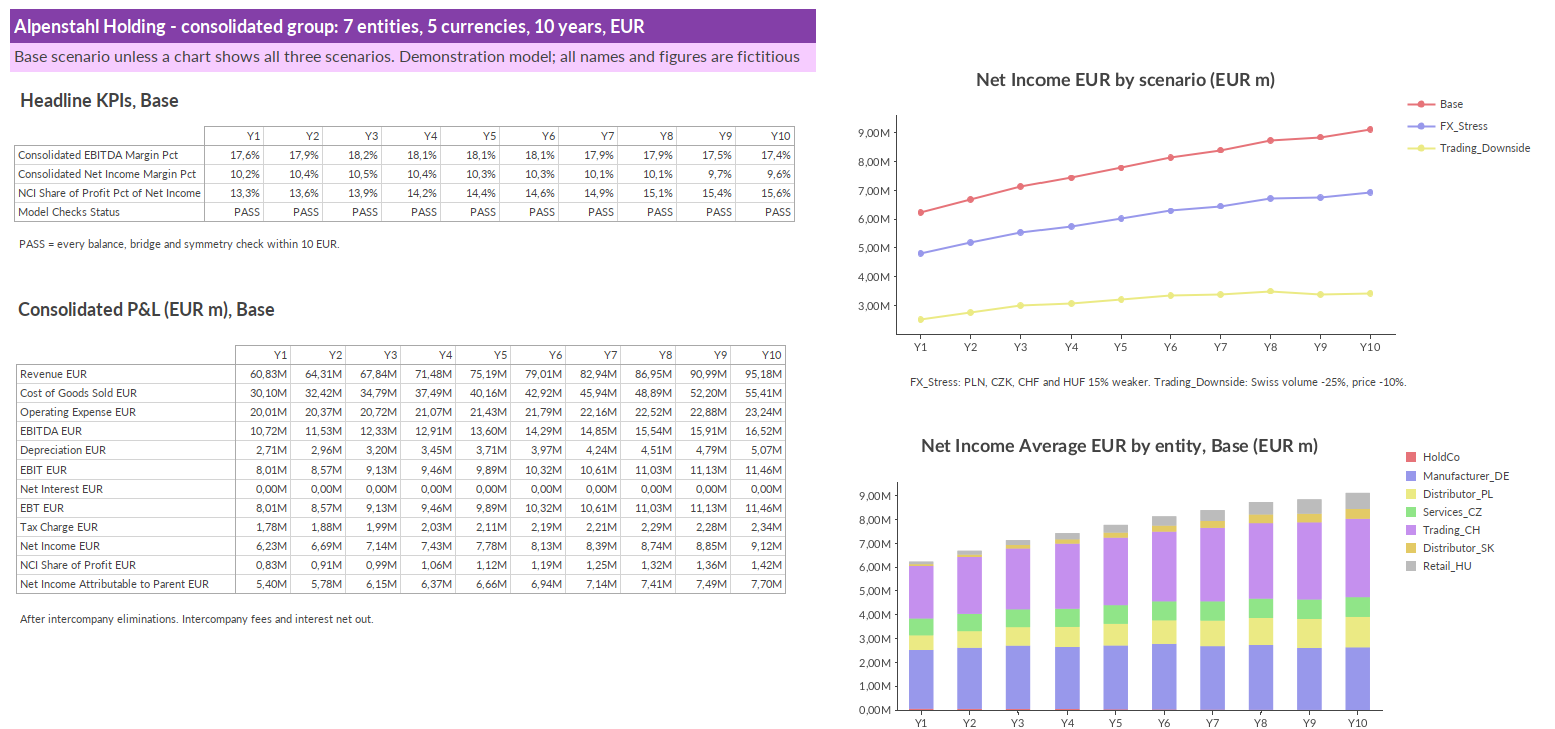
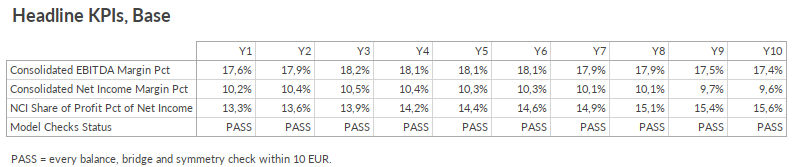
| Base results | Revenue EUR 60.8m → 95.2m, EBITDA margin about 18%, net income EUR 6.2m → 9.1m (year 1 → year 10) |
| Availability | Free with the 30-day Quantrix trial |
What is a holding company consolidation model?
A consolidation model combines the financial statements of a parent and its subsidiaries into one set of group statements. To do that it translates each subsidiary into the group currency, removes transactions between group companies (intercompany eliminations), and splits profit and equity between the parent and the minority shareholders (non-controlling interests, NCI).
In Excel this usually means one workbook per subsidiary, a translation sheet per currency and a consolidation sheet full of hand-written eliminations. Every new entity or ownership change touches all of them. This model does the same job in one Quantrix model.
Which companies are in the model?
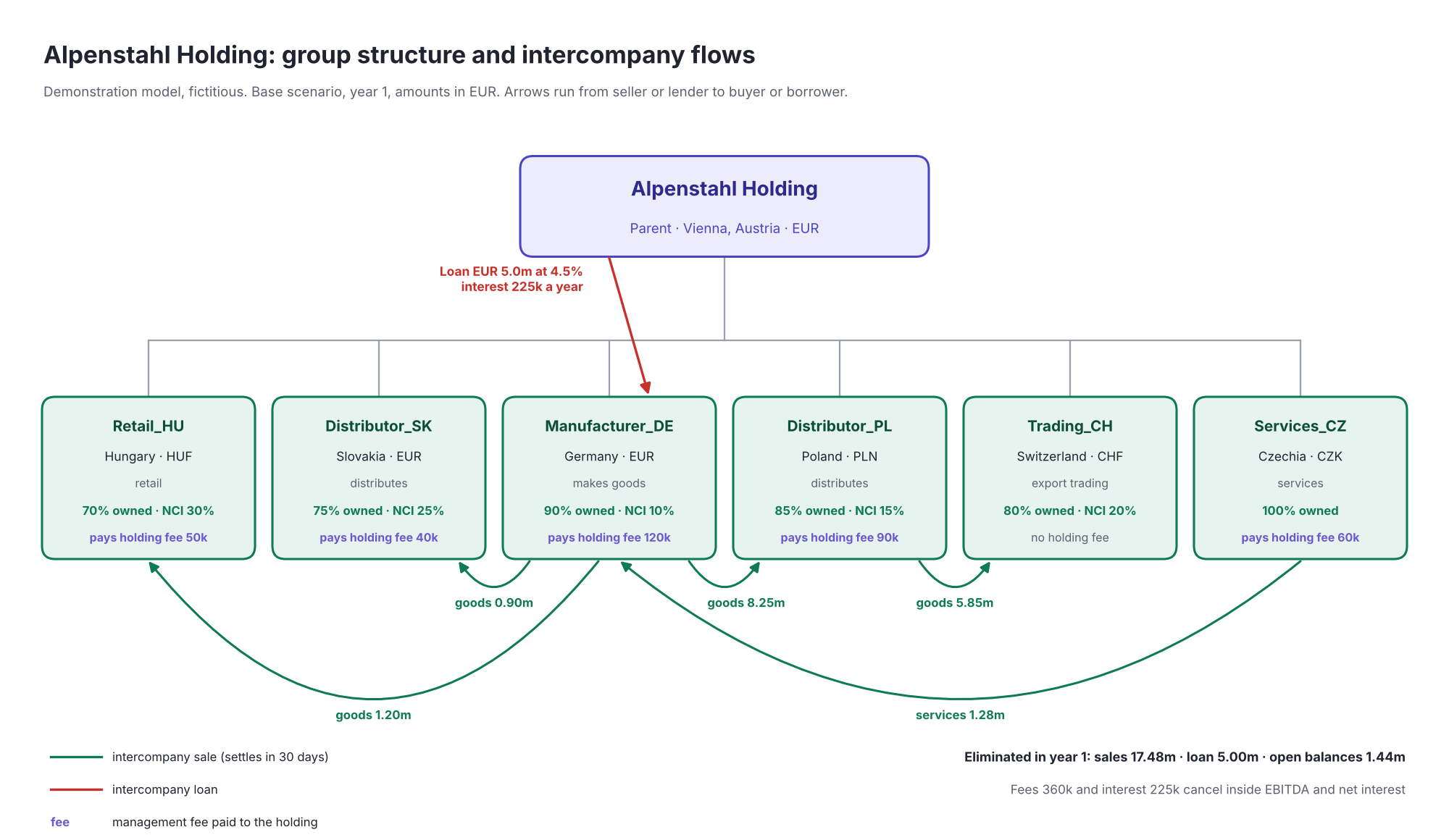
The model contains a fictitious group, Alpenstahl Holding, with a parent in Vienna and six subsidiaries. Each subsidiary has simple drivers: volume × price for sales and a cost per unit for cost of goods sold. The mechanics are generic, not sector-specific.
| Entity | Country | Currency | Owned |
|---|---|---|---|
| HoldCo (parent) | Austria | EUR | – |
| Manufacturer_DE | Germany | EUR | 90% |
| Distributor_PL | Poland | PLN | 85% |
| Services_CZ | Czechia | CZK | 100% |
| Trading_CH | Switzerland | CHF | 80% |
| Distributor_SK | Slovakia | EUR | 75% |
| Retail_HU | Hungary | HUF | 70% |
Three kinds of intercompany flows link the entities:
- Internal sales: Germany to Poland, Slovakia and Hungary; Poland to Switzerland; Czechia to Germany, with the matching receivables and payables.
- Management fees: the holding charges five subsidiaries EUR 360,000 a year in total.
- Intercompany loan: the holding lends Germany EUR 5 million at 4.5%, repaid at the end.
Which assumptions can you change?
You can change every driver, per entity, year and scenario:
- Sales volumes and prices, external and intercompany
- Cost per unit for each entity’s own production or outside purchases
- Ownership percentage per subsidiary
- Average, closing and historical exchange rates for PLN, CZK, CHF and HUF
- Management fees, loan amount and interest rate
- Operating costs, capex, asset lives, tax rates, receivable and payable days
- Opening balance sheets
Three scenarios are included:
- Base
- FX_Stress: PLN, CZK, CHF and HUF 15% weaker against the euro
- Trading_Downside: Swiss external volume −25% and price −10%, while purchases and costs stay put
How are intercompany transactions eliminated?
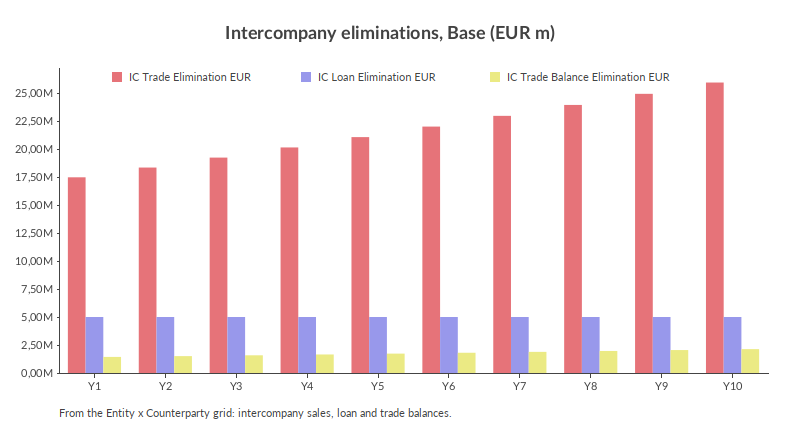
Every intercompany amount is entered once, in a single grid of seller by buyer, in euros. Each company books its side in its own currency; at consolidation, the eliminations read the same grid, so the seller’s revenue and the buyer’s cost of goods sold, the lender’s receivable and the borrower’s payable cancel exactly. Fees and interest cancel inside EBITDA and net interest.
How is the currency translation reserve (CTA) calculated?
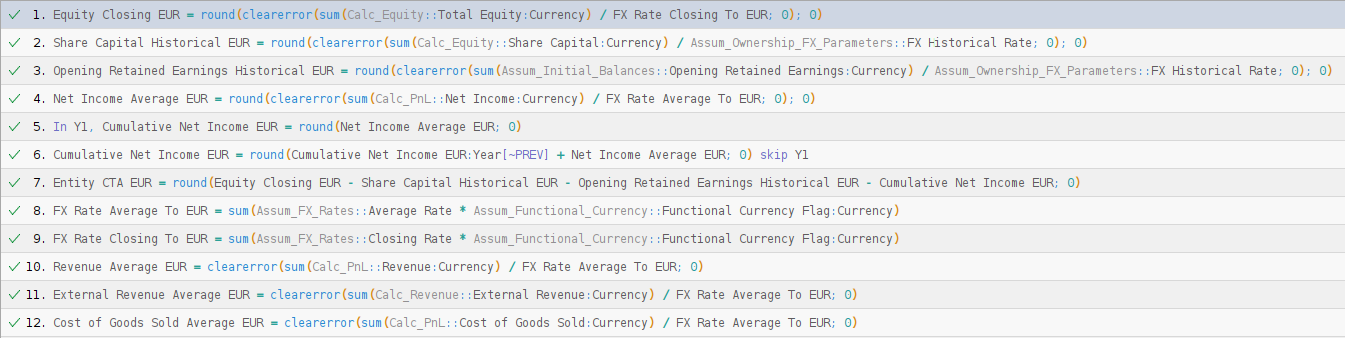
The model uses the current-rate method of IAS 21: income statements are translated at the average rate, balance sheets at the closing rate, and share capital and opening retained earnings at historical rates. The difference is the currency translation reserve, also called the cumulative translation adjustment (CTA). The model calculates it per entity, never as a balancing figure, and gives the minority shareholders their share of it.
Because the reserve is calculated rather than forced, the balance sheet check is meaningful: if the consolidated balance sheet balances, the translation really adds up.
What results does the model produce?
The model produces income statements, balance sheets and cash flows per entity in local currency, a translated layer in euros, and consolidated statements over ten years and three scenarios.
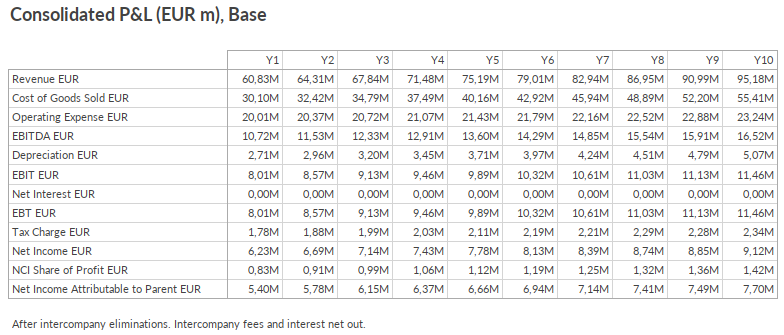
In the Base scenario, consolidated revenue grows from EUR 60.8 million in year 1 to EUR 95.2 million in year 10, EBITDA from EUR 10.7 million to EUR 16.5 million, and net income from EUR 6.2 million to EUR 9.1 million.
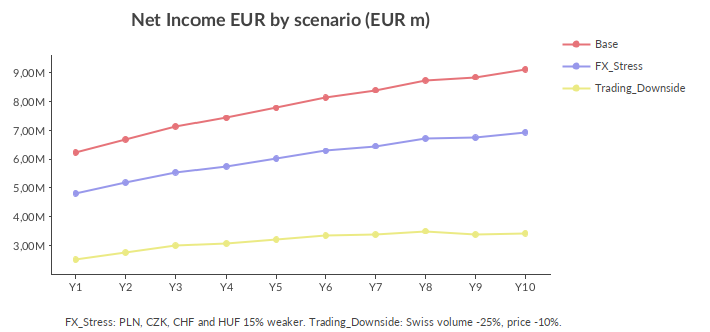
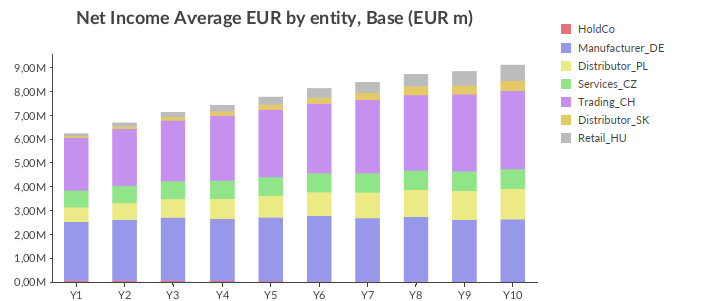
Under FX_Stress, year-10 net income falls to EUR 6.9 million and the translation reserve to about EUR −2.1 million; the balance sheet still balances. Under Trading_Downside, the Swiss trading company makes a loss and group net income in year 10 falls to EUR 3.4 million.
How does the model check itself?
The model runs its own checks and shows the result on the dashboard as PASS or REVIEW. A consolidation can look right and still be wrong: a missing elimination or an unbooked fee does not stop the totals from adding up. The checks are:
- Each entity’s balance sheet balances in its own currency
- The consolidated balance sheet balances, with the translation reserve calculated independently
- Consolidated revenue matches the sum of external revenue
- Consolidated EBITDA matches revenue minus cost of goods sold and operating costs after eliminations
- Intercompany fee income equals fee expense, interest income equals interest expense, receivables equal payables
- No asset is depreciated below zero
How do you add a subsidiary without new formulas?
In Quantrix, you add a subsidiary by adding one item to the entity list and loading its data; consolidation, eliminations, NCI and checks extend to it automatically. We tested this twice on this model.
A Slovak distributor in euros. One item, Distributor_SK, plus its inputs: ownership, opening balance sheet, sales, costs and its intercompany purchases from Germany. No formula was added or changed, and the results matched an independent recalculation to the euro.
A Hungarian retailer in forints. The second test added a new currency and exposed a weakness: the original translation formulas named the four currencies they knew, so a forint subsidiary would have been left out of the consolidated totals. We changed the translation once, so that every entity is translated at the rate of its own currency, whatever it is. After that, adding HUF and Retail_HU took one item in each list plus the inputs, again without a new formula, and again the results matched to the euro.
Why build a consolidation model in Quantrix rather than Excel?
Quantrix treats Entity, Currency, Year and Scenario as dimensions of one model, so one formula covers every entity, year and scenario. In Excel, each subsidiary is usually a copy of the same sheet and each elimination a formula someone wrote by hand; add a subsidiary and you copy sheets, extend ranges and add eliminations, and if you miss one, nothing tells you.
In this model, all intercompany amounts sit in one grid, so eliminations are a few generic formulas rather than a list. Change an ownership percentage and the non-controlling interests recalculate through every statement. Add a subsidiary, and it is one item plus its data.
How was this model built?
The model was generated from a plain-language brief with our AI Quantrix model builder, then reviewed and tested: an independent recalculation of every consolidated figure and the two add-a-subsidiary tests. The review also improved the model, for example by making the currency translation generic and by adding cost of goods sold from outside suppliers. The same method works for your own group structure, currencies and intercompany flows.
What does the model not include?
It is a demonstration of consolidation mechanics, not a statutory consolidation tool:
- No acquisition accounting: no investment in subsidiary, no goodwill, no equity-method associates
- No elimination of unrealised profit in inventory, and no tax loss carry-forward
- No external borrowing: the only interest is on the intercompany loan, which eliminates
- Intercompany loans in euros only; no FX gains and losses on intercompany balances, and no consolidated cash reconciliation
Get the model with your free trial
The model is included with the free 30-day Quantrix trial. Request the trial below and we will send you the model with the download link. If you would like it adapted to your own group structure, say so in the message field.
Get Full Access to Quantrix – Free for 30 Days
We ask for a few details to send your download link and help you get started. Your info stays private, no spam, no credit card.
Why It is Worth Your Time: